


On this page
Start with the line you intend to fish and the amount you want on the reel. For a setup built around 14–16 lb nylon, the standard TW 100 is a useful starting point. Consider the SV TW 100 when its smaller spool and BOOST mechanism are central to your casting choice; move toward the 200, 300 or 400 when their published capacities answer a specific line requirement. Then choose the retrieve that suits your presentation.
This guide covers the 24 Tatula TW 100, 25 Tatula SV TW 100, 25 Tatula TW 200H, 21 Tatula TW 300XH and 21 Tatula TW 400 as representatives of their families. It is a selective JDM buying guide, with a representative variant lookup rather than an exhaustive list of every speed and handle combination. Numerical specifications below are attributed to Daiwa Southeast Asia; construction and mechanism details come from Daiwa Japan.
Featured image source: DAIWA Japan official source
Who should choose each family
The recommendations here use the same criteria throughout: required nylon capacity, spool and braking design, retrieve per handle turn, and reel weight. They are editorial judgments based on published specifications. Choose the branch that solves your fishing task, then confirm suitability for your exact lure and rod.

Daiwa 24 Tatula TW 100 baitcasting reel, right-handle model.
| Your priority | Starting choice | What could change the choice |
|---|---|---|
| A 14–16 lb nylon setup with the standard 100's published reserve | TW 100 | Choose the SV branch for its different spool and BOOST design, after checking its capacity notation against your intended fill. |
| A 100-family reel selected around a 32 mm spool and two-stage BOOST rotor | SV TW 100 | Choose standard TW 100 if its explicit 14–16 lb capacity and 67 cm pickup better match the job. |
| More 16 lb nylon reserve, or a setup requiring the listed 20–25 lb capacities | TW 200H | Stay with a 100 if its capacity meets your requirement and lower reel weight matters more. |
| More 20–25 lb nylon reserve than the 200H, paired with rapid pickup | TW 300XH | Choose 200H if its reserve is sufficient; consider 400 if 25–30 lb capacity is the priority. |
| 25 lb–180 m or 30 lb–140 m nylon capacity | TW 400 | Choose 300XH if its capacity is sufficient and 109 cm pickup better suits the presentation. |
[[JDMAS:standard-tw-100]]
Representative specifications and variant lookup
Use the full model code when matching a product to these figures. The table combines Daiwa Southeast Asia's representative specification rows with Daiwa Japan's spool details. The 200H and 300XH are different-ratio selections; they should not be read as a speed-matched comparison with the base 100 or 400.
| Representative model | Weight | Ratio | Retrieve per handle turn | Published nylon capacity | Spool diameter |
|---|---|---|---|---|---|
| 24TATULA TW 100 | 195 g ≈ 6.9 oz | 6.3 | 67 cm ≈ 26.4 in | 14 lb–115 m / 16 lb–100 m | 34 mm ≈ 1.34 in |
| 25TATULA SV TW 100 | 195 g ≈ 6.9 oz | 6.3 | 63 cm ≈ 24.8 in | 12–40–80, 14–35–70; original notation | 32 mm ≈ 1.26 in |
| 25TATULA TW 200H | 225 g ≈ 7.9 oz | 7.3 | 87 cm ≈ 34.3 in | 16 lb–170 m / 20 lb–135 m / 25 lb–100 m | 38 mm ≈ 1.50 in |
| TATULA TW 300XH | 325 g ≈ 11.5 oz | 8.1 | 109 cm ≈ 42.9 in | 20 lb–185 m / 25 lb–145 m | 43 mm ≈ 1.69 in |
| TATULA TW 400 | 335 g ≈ 11.8 oz | 6.3 | 85 cm ≈ 33.5 in | 25 lb–180 m / 30 lb–140 m | 43 mm ≈ 1.69 in |
What the size numbers mean for this decision
Treat 100, 200, 300 and 400 as family labels, then compare the measurements that matter to you. The two 100-family choices here use different spool diameters: 34 mm for standard TW and 32 mm for SV TW. The 200 uses 38 mm, while the 300/400 family uses 43 mm. Standard 100, SV 100 and 200 spool widths are each 24 mm, approximately 0.94 in.
Daiwa identifies the standard 100, SV 100, 200 and 300/400 spools as ultra-high-strength duralumin (Japanese: 超々ジュラルミン). The Japanese term is included here only to match the wording on the official product pages; the family-specific diameters and capacities above remain the useful buying differences.
The 300/400 spool is documented as a MAGFORCE spool. See Daiwa Japan's TW 100 construction details, SV TW details, TW 200 details and TW 300/400 details.
The practical lesson is clearest with the 300 and 400: a shared published spool diameter does not make their nylon capacities identical. Likewise, the shared 100 label does not make standard TW and SV TW interchangeable. Use capacity and construction together, and assess palm fit separately.
Technology and construction differences
The brake name matters because the mechanism changes how the spool is controlled during a cast. Daiwa describes MAGFORCE-Z as a variable system: spool speed and centrifugal force move the inductor rotor into the magnetic field for stronger braking early in the cast, then let it return as spool speed falls. The official graphic below highlights the inductor area around the spool and shows where electromagnetic induction creates braking force.
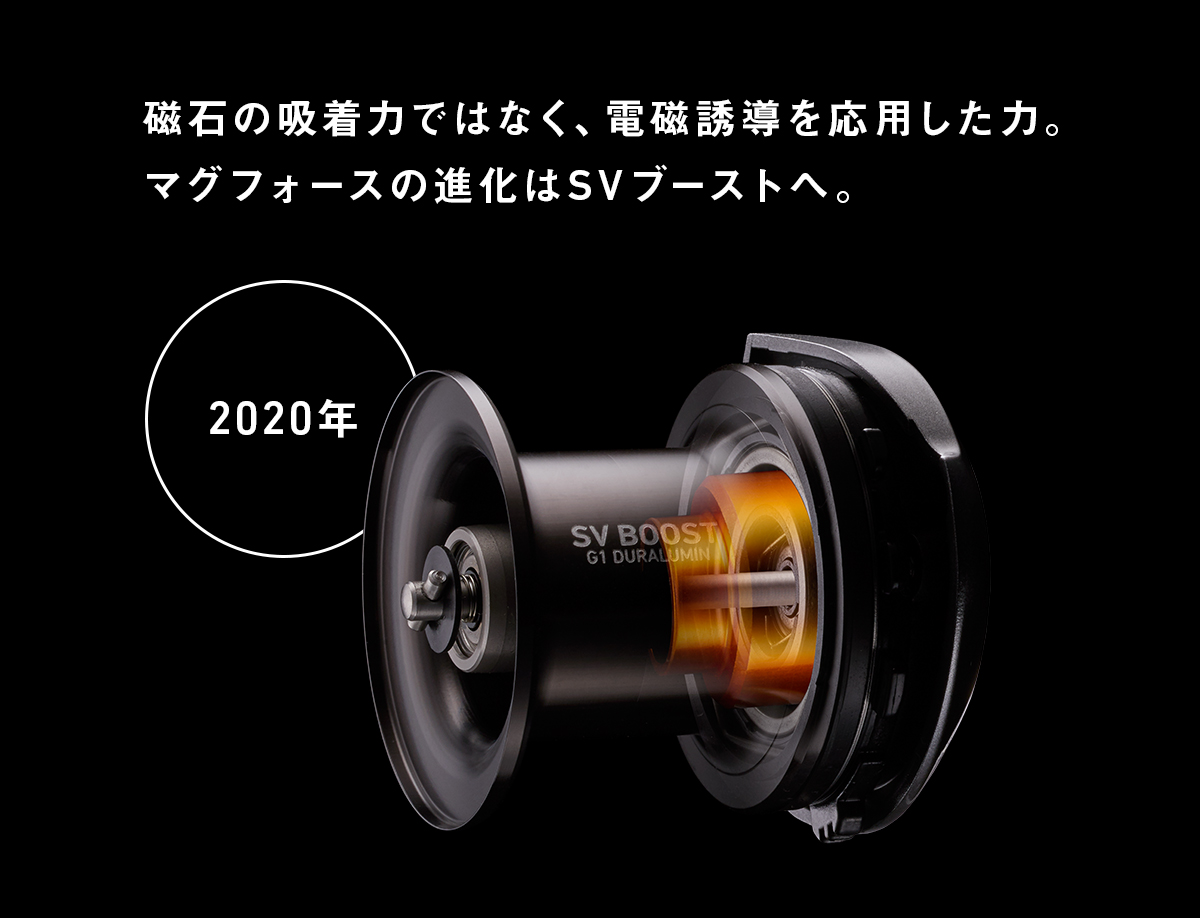
The highlighted inductor area shows where electromagnetic induction creates braking force around the spool. Source: DAIWA Japan official BOOST SYSTEM technology story
The inductor rotor is the orange cylindrical part attached to the spool in Daiwa's component image. It rotates between the paired magnetic rings without contacting them; the resulting electromagnetic induction provides braking. This image identifies the parts being discussed and helps distinguish the mechanism from a conventional friction brake.
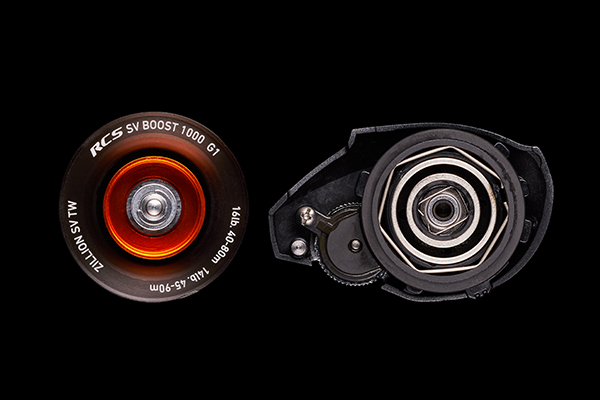
The orange inductor rotor and the paired magnetic rings used by the MAGFORCE brake system. Source: DAIWA Japan official BOOST SYSTEM technology story
Daiwa's SV BOOST explanation adds a separate distinction: its inductor rotor extends in two stages. That documented construction is the reason to compare the SV TW 100 with the standard TW 100 by casting-system preference, rather than assuming that two reels carrying the 100 label behave identically. See the DAIWA MAGFORCE-Z technology explanation and DAIWA BOOST SYSTEM story for the manufacturer descriptions and image context.
Matched-size head-to-head comparisons
The standard TW 100 and SV TW 100 make the most direct comparison here: both representative rows list 195 g and a 6.3 ratio. Their differences lie in spool geometry, casting mechanism, capacity notation and pickup—not a weight saving in these particular models.

Daiwa 25 Tatula SV TW 100 baitcasting reel, right-handle model.
Standard TW 100 versus SV TW 100
Daiwa documents the standard TW 100's MAGFORCE-Z as using an inductor rotor that responds to spool speed, allowing stronger braking early in the cast and weaker braking later. For SV BOOST, Daiwa identifies a rotor that extends in two stages as the distinguishing feature. These are descriptions of mechanism operation, not comparative casting scores.
For repeated casts with a lure you intend to fish on 14–16 lb nylon, the standard TW 100 is the straightforward capacity-led recommendation if its listed reserve meets your needs. Its 34 mm spool and MAGFORCE-Z design provide a clear reference against which to consider the SV alternative.
Consider the SV TW 100 when you specifically want its 32 mm spool and two-stage BOOST mechanism. Confirm how your exact lure's weight, shape and casting task suit the reel before choosing it on casting grounds.
At the same listed ratio, standard TW 100 retrieves 67 cm per turn against the SV's 63 cm: a difference of 4 cm, approximately 1.6 in. Choose between those pickup rates according to the pace you want. The SV also has an 85 mm aluminum crank handle, approximately 3.35 in, with high-grip I-type light knobs. Check that handle configuration against your preferred grip. These mechanism and handle details are documented on Daiwa Japan's TW 100 and SV TW pages.
[[JDMAS:sv-tw-100-casting-choice]]
TW 300XH versus TW 400
Choose the 300XH when its 20 lb–185 m or 25 lb–145 m nylon capacity meets your reserve requirement and fast pickup is part of the job. Choose the 400 when 25 lb–180 m or 30 lb–140 m is the capacity you want and 85 cm pickup suits the retrieve.
At 25 lb, the published difference is 35 m, approximately 38 yd, in favor of the 400. The 400 weighs 10 g more, approximately 0.35 oz, while the 300XH retrieves 24 cm more per turn, approximately 9.4 in. Use these exact variants' capacity and pickup figures to make the choice, and confirm suitability for your lure.
Use-case recommendations
Write down the exact lure, casting task, line material and diameter, desired casting length, and reserve you want to retain. The branches below turn those requirements into a starting choice. They are editorial interpretations of the published capacities and retrieve figures, not lure-weight ratings.

Daiwa 25 Tatula TW 200H baitcasting reel, right-handle model.
A 16 lb nylon setup that needs more reserve
If you want more than the standard TW 100's listed 100 m of 16 lb nylon, start with the 200H's 170 m figure. That is 70 m more, approximately 77 yd, for a 30 g increase in reel weight, approximately 1.1 oz. The 200H also gives 87 cm pickup rather than 67 cm.
For a lure you plan to cast farther while retaining more line, this is a concrete reason to investigate the 200H. Confirm capacity for your actual line diameter and suitability for the exact lure; do not treat the larger spool as a casting-distance guarantee.
A 20–25 lb nylon setup with repeated retrieves
Start with the 200H if 20 lb–135 m or 25 lb–100 m meets your plan. Daiwa specifies a 100 mm aluminum crank handle, approximately 3.94 in, with high-grip I-shape power large knobs. It also documents a size-200-specific TWS line guide with a tapered shape and optimized passage width. Those are useful features to assess when comparing grip and line-guide fit for your setup. See Daiwa Japan's TW 200 details.
For a lure with substantial retrieve resistance, compare that handle configuration and 87 cm pickup with the pace and grip you want. Confirm suitability under your intended load rather than treating handle length or gear ratio as a torque rating.
[[JDMAS:tw-200h-line-reserve]]
A 20–25 lb setup where reserve and rapid pickup both matter
If your lure presentation calls for retrieving slack quickly and you want more line than the 200H's listed capacities, the 300XH is the stronger starting candidate. It lists 20 lb–185 m and 25 lb–145 m with 109 cm pickup. The trade-off is weight: 325 g against the 200H's 225 g, an increase of 100 g, approximately 3.5 oz.
Make that jump for a defined reserve and pickup need. For your exact lure, confirm both casting suitability and the retrieve effort you are willing to accept.
[[JDMAS:tw-300xh-fast-pickup]]
A 25–30 lb setup chosen primarily for capacity
Start with the 400 if you specifically want its 25 lb–180 m or 30 lb–140 m nylon capacity. For a larger lure setup, first decide whether those line requirements actually apply; lure size alone is not the selection rule used here. The 400's 85 cm pickup and 335 g weight should also fit your intended retrieve and rod combination.
[[JDMAS:tw-400-heavy-line-reserve]]
Check line, lure and combo fit before buying
Use the published nylon figures as your reference, then confirm the fill for the exact line you intend to use. Check material and diameter alongside pound-test; for a braid or PE setup, obtain capacity guidance for that specific line rather than substituting the nylon figures. Include the line you expect to have out and the reserve you want left on the spool.
For lure fit, confirm the exact lure's weight and casting characteristics against the reel and rod you are pairing. For short target casts, investigate the casting mechanism you prefer. For longer casts, establish the line requirement first. For resistant retrieves, assess pickup and handle configuration together. Tie your choice to those checks and confirm lure suitability before buying.
For comfort, compare the listed weights, then assess palm fit, rod balance and handle reach with your intended combo. The 100 representatives weigh 195 g, the 200H 225 g, and the large representatives 325–335 g. Decide whether the extra capacity and pickup serve enough of your fishing to justify that weight. Confirm right-hand retrieve before following the representative product links.
To browse beyond these choices, use the Daiwa brand collection. For any other listing, match the full model identity and its own specifications before carrying over a recommendation from this guide.
Key official references

Standard 100 starting point
Daiwa 24 Tatula TW 100 (Right Handle)

SV casting-system alternative
Daiwa 25 Tatula SV TW 100 (Right Handle)

Intermediate capacity choice
Daiwa 25 Tatula TW 200H (Right Handle)

Large-capacity fast-pickup choice
Daiwa 21 Tatula TW 300XH (Right Handle)

Larger nylon-capacity choice


